Journal · Guide10 min read
What is a game facilitator? Role, skills, settings and how to become one in 2026
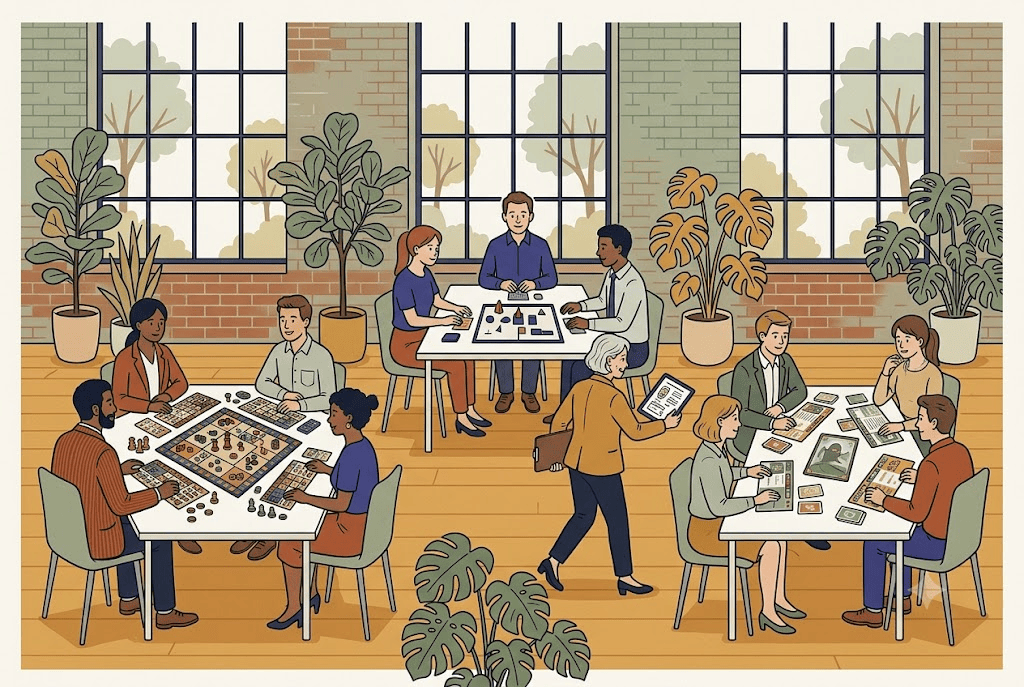
A game facilitator is a professional who uses a game, simulation or structured play to help a group reach a learning, team or change goal: they choose or adapt the game, prepare the group, run the session, keep it safe and on purpose, and lead the debrief where players turn what happened at the table into decisions for real life. Game facilitation is practiced in business simulations, transformational games, classrooms, team building and therapy-adjacent work. You become a game facilitator through played experience, co-facilitation, supervised practice and a portfolio of real sessions; a method-agnostic professional certification for the field is being drafted now with founding members of the International Association of Game Facilitators.
Founding membership is free and takes about two minutes to apply. You receive a numbered Founding Member certificate with a public verification link the minute you apply, and founding membership stays free.
What is a game facilitator? A one-paragraph definition
A game facilitator designs, runs and debriefs games for a group so that the group achieves a stated goal outside the game.
The goal can be learning a concept, making better decisions, building trust in a new team or exploring a personal question. The game is the method; the facilitator is accountable for the outcome. That accountability separates facilitation from simply hosting a game night, and it explains why the same game can produce very different results in different hands.
| Role | Main job | Success looks like |
|---|---|---|
| Game facilitator | Uses a game to move a group toward a goal outside the game, then debriefs it | Participants can name what they learned and what they will do differently |
| Trainer | Transfers defined knowledge or skills, often through presentation and exercises | Learners pass an assessment or apply a skill |
| Game master / host | Runs the rules and story of a game for the players' experience | Players enjoy the game and want to play again |
| Game designer / author | Creates the mechanics, materials and rules | The game works reliably across groups and facilitators |
Many professionals hold two of these roles at once. An author who runs their own game, or a trainer who brings a simulation into a program, still needs the facilitator's skills from the moment a group sits down.
What a game facilitator does before, during and after a game
A game facilitator's work runs in three phases: preparation, live play and debrief, and the debrief is where play turns into learning.
Before the game
The facilitator agrees the purpose with whoever commissioned the session, then picks a game whose mechanics create the behavior worth discussing: a negotiation game for negotiation, a cooperative game for team communication, a resource game for financial decisions. They adapt timing and group size, prepare materials and decide in advance which questions the debrief will ask.
During the game
Live play is observation work. The facilitator explains rules and purpose briefly, keeps the pace, watches who speaks and who goes silent, notes moments to return to later and steps in when a moment carries more emotional weight than the group expected.
After the game: the debrief
The debrief is a structured conversation that connects what players did in the game to how they act outside it. Simulation researcher David Crookall called debriefing “vital both for learning and for establishing simulation/gaming as a discipline” (Simulation & Gaming, 2010). A common sequence moves from facts, to feelings, to parallels with real life, to one concrete next step.
Where game facilitators work
Game facilitators work wherever a group needs to learn, decide or connect: companies, schools and universities, hospitals, coaching practices and community programs.
- Business simulations and serious games. Strategy, negotiation, finance and leadership simulations that organizations buy to change how people decide. See the Business Games hub.
- Transformational games. Deep play for personal growth, insight and change, where the facilitator's care for each player matters most. See the Transformational Games hub.
- Education. Game-based learning in classrooms, universities and professional training. A financial-literacy example: the Life Capital Trainer School prepares facilitators to run a board simulation, including the debrief where players connect their moves to their own decisions.
- Team building. Trust and collaboration through shared play, from onboarding new teams to repairing working relationships.
- Therapy-adjacent practice. Games used for well-being, reflection and social connection. Facilitators here keep clear boundaries and refer clinical needs to licensed professionals.
Game facilitator skills
The core game facilitator skills are ethics and safety, facilitation craft, game literacy, reflection and transfer, evidence of practice and continuing development.
These six areas are the assessment domains proposed in the association's draft certification framework. Here is how each one shows up in a real session.
| Skill area | What it looks like in the room |
|---|---|
| Ethics & safety | Clear consent, an opt-out that carries no penalty, care when a game touches personal material |
| Facilitation craft | Tight briefing, steady pacing, reading the group, managing dominant and quiet players |
| Game literacy | Choosing a game whose mechanics fit the goal, and adapting rules, time and group size |
| Reflection & transfer | A debrief that ends with named insights and concrete next steps |
| Evidence of practice | Session notes, participant feedback and outcome data collected into a portfolio |
| Continuing development | Peer supervision, new games and methods, current research |
How to become a game facilitator
Most game facilitators build the role in five steps: play widely, co-facilitate, run supervised sessions, document a portfolio and join a professional community.
- Play as a participant. Experience the games you want to run, ideally with an experienced facilitator, and notice what the debrief does for you.
- Co-facilitate. Assist someone experienced: set up, observe, take notes, run part of the debrief.
- Lead under supervision. Run full sessions with feedback from a peer or mentor.
- Build a portfolio. Keep a record of groups, goals, what happened and what changed.
- Join the profession. Connect with peers in a thematic or regional hub and contribute to the standards.
Some game authors run their own certification for their title. The Life Capital Trainer School, for example, combines a 7-hour starting training, five weekly online practice sessions and 12 supervised sessions at a real table, three in each of four roles, with an optional online exam for the certificate.
What the association's certification will cover
The International Association of Game Facilitators is developing a method-agnostic game facilitator certification. There is no fixed public launch date yet: the framework is being drafted with founding members and will be followed by a pilot. The draft proposes three levels (Associate, Certified, Senior / Lead) and a path of application, foundations, supervised practice, portfolio and peer review. A recognition-of-prior-practice route is planned, so experienced facilitators can enter at the level their portfolio supports. Details are on the certification page, and the wider membership offer is on the Association page.
Founding members join the working group that defines competencies, ethics and assessment, and can apply to curate a hub.
Two fresh examples from September 2026
Two September 2026 reports show where the field is heading: evidence that facilitated games work in high-stakes teams, and AI that can generate game-based learning on demand.
A card game on hospital rounds
On 25 September 2026 the AMA reported on Round34, a cooperative card game created by physicians at Jefferson Health. In a 22-week randomized study, residents on teams that played it during teaching rounds, moderated by the attending physician, rated rounds higher for educational value (8.0 vs 6.2), engagement (8.5 vs 7.1) and comfort asking questions (9.1 vs 8.2), with no change in rounding time (Journal of Graduate Medical Education, 2026). In our reading, the attending was acting as the game facilitator. Our news summary covers the numbers and limits.
AI-generated learning interactives
On 17 September 2026 Google Research described “learning interactives”: guided STEM simulations generated with AI and built as game levels of increasing difficulty, with hints and feedback. Google released a library of more than 30 teacher-reviewed interactives in English. In its evaluation, UK STEM teachers rated 40 interactives against pedagogical criteria, and in an initial study 12 US teachers, each requesting three custom interactives, gave their quality an average of 8 out of 10. Teachers approve the learning objectives and vet each interactive before it enters the library (tech report). Our view: as generating a game gets cheaper, the scarce skill moves to choosing it, running it and debriefing it. The AI Game Facilitation hub, now forming, gathers members around that skill.
FAQ
What does a game facilitator do?
A game facilitator prepares a group and a game around a clear goal, runs the session, keeps it safe and on track, and leads a debrief that connects what happened in the game to real work or life.
How do I become a game facilitator?
Play the games you want to run, co-facilitate with someone experienced, lead sessions under supervision, keep a portfolio of real sessions and join a professional community such as the International Association of Game Facilitators, where founding membership is free.
Is there a game facilitator certification?
Some game authors certify facilitators for their own titles. A method-agnostic professional certification is in development at the International Association of Game Facilitators, with three proposed levels and no fixed launch date yet.
What skills does a game facilitator need?
Ethics and safety, facilitation craft, game literacy, reflection and transfer, evidence of practice and continuing development.
What is the difference between a game facilitator and a game master?
A game master runs the game for the players' experience. A game facilitator uses the game to reach a goal outside it and is accountable for that outcome, usually through a structured debrief.
- A free application that takes about two minutes
- A numbered certificate with a public verification link, issued instantly
- Founding membership that stays free after the association opens paid tiers
- First place in the Global Directory, in member-number order, when it opens
- A voice in the certification standard and the option to lead a hub
Sources: Baig et al., J Grad Med Educ 2026;18(1):43–50; AMA, 25 September 2026; Google Research, 17 September 2026; arXiv 2609.20738; Crookall, Simulation & Gaming 41(6), 2010.